

Keeping Children Safe in Education 2026 is out.
What actually matters if your school supports learners with SEND
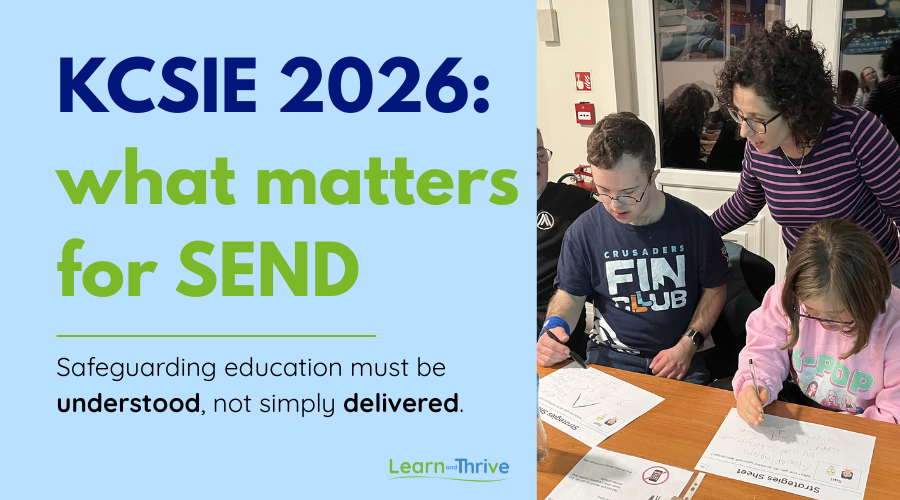
Keeping Children Safe in Education 2026 has landed. And yes, before you ask, you do need to read it. All of it. In fact, that is now officially non-negotiable, which we’ll get to in a moment.
But rather than sending you a summary of every paragraph, this piece focuses specifically on what has changed for schools supporting learners with SEND. Because there is more in this version than any that came before it, and some of it requires action now.
First: the change that affects everyone, immediately
The condensed Annex A — the shortened version of Part One that non-child-facing staff were previously permitted to read — has been removed. Every member of staff must now read Part One in full.
That means your induction process needs updating. Your annual training records need updating. And the assumption that only “frontline” staff need a full picture of safeguarding is, as of this version, over.
What this means for your school: Check your induction and training documentation. If your policy currently references Annex A, update it. This is a compliance change, not a suggestion.
What KCSiE 2026 finally says about learners with SEND
For the first time, the guidance explicitly names disabled children in Para 13 as a group requiring their own clear procedures and processes. Not bundled under a catch-all. Named directly.
And then there is this, in the section on safeguarding education:
“It should be recognised that effective education will be tailored to the specific needs and vulnerabilities of individual children, including children with special educational needs and/or disabilities (SEND).
And further:
“Such a programme should be fully inclusive and developed to be age and stage of development appropriate, especially when considering the needs of children with SEND.”
Age and stage appropriate. Those of us in SEND education have been saying this for years. Genuinely good to see it in statutory guidance.
A quick note on what this actually means: age and stage appropriate does not mean waiting until a child is “ready” to learn about sexual feelings, touch, relationships, or sex. It means teaching those things in a way that makes sense for where that learner is. Waiting is no longer a defensible position, and for many of our young people, it never was. We have written about this in more depth here.
The guidance also names the specific barriers that make SEND learners more vulnerable. These are worth your time:
Indicators of abuse can be misread as part of a child’s condition
SEND learners are more prone to peer isolation and bullying, including prejudice-based bullying
They may be disproportionately impacted without showing obvious outward signs
Communication barriers can make it genuinely difficult to report what is happening
Cognitive understanding can make it hard to distinguish fact from fiction in online content, or to understand the consequences of what they share
What this means for your school: Your child protection policy must now reflect these barriers specifically. Review it with your SENCO and DSL together. Does it actually account for how abuse might present differently in a child with a learning disability? If not, that is your starting point.
The easy to miss parts
The single most significant change in KCSiE 2026 is also the easiest to miss. The entire child-on-child abuse section has been reframed around harmful sexual behaviour.
This is not a renaming exercise. Two brand new paragraphs (Paras 33 and 34) say something no previous version of KCSiE has said.
Child-on-child abuse is a safeguarding issue for both the victim and the person who caused the harm.
And it is preventable.
Para 34 is worth quoting in full: “all staff should know that timely, evidence-based support can be key to preventing children from going on to commit abuse or violence.”
This is a fundamentally different frame. The guidance is not just asking schools to respond better after something has happened. It is saying that if children understand relationships, consent, healthy behaviour and what is and is not acceptable, you can prevent harm from happening in the first place.
Education as safeguarding. Not education alongside safeguarding. We think this distinction is at the core of everything — and it has been our guiding principle since we started Learning for Life.
Why this is urgent for SEND settings
Children with learning disabilities are statistically among the most vulnerable to sexual abuse and exploitation. They are also, too often, the children least likely to have received age and stage appropriate relationships and sex education. Not because schools do not care, but because resources designed specifically for this group have been almost non-existent.
There is also a risk that often does not get named clearly enough: without this education, some young people may inadvertently cause harm themselves. Not out of malice. Because nobody taught them what was and was not appropriate, or because their behaviour was written off as “part of the diagnosis” rather than recognised as something that needed a proper response. KCSiE 2026 is clear that harmful sexual behaviour is a safeguarding issue for the child who causes harm, not just the child who experiences it. That framing changes what schools are responsible for.
KCSiE 2026 now tells schools that:
Harmful sexual behaviour is preventable
Education is the prevention
That education must be appropriate for learners with SEND
Three duties, stacked on top of each other. No guidance on how to deliver any of them for this group.
What does “timely, evidence-based support” actually look like for a young person with a learning disability? What does accessible, sequenced relationships education look like for someone who needs explicit teaching rather than inference — the kind that builds from “what is a relationship” all the way to understanding coercive control?
It is a genuine curriculum challenge, and it is the one that Learning for Life was built to address. From September we are launching our full Consent & Decisions Series, which works through this from the foundations up. If you want to understand more about the thinking behind our approach, this piece is a good place to start: Why stage-based RSE policy fails SEND learners.
What this means for your school: Review your current safeguarding education for SEND learners. Is it reactive, or does it include genuine preventative curriculum? Can you evidence that learners understand consent, healthy relationships and how to report concerns in a way that is meaningful for their level of understanding? This is what Ofsted will be looking for, and it is what keeps young people safe.
Online harms: the list just got longer
KCSiE 2026 adds AI-generated images, deepfakes, misogynistic influencers, and generative AI that simulates harmful contact to the risks schools must address. The definition of nudes and semi-nudes now explicitly includes images “wholly generated using artificial intelligence.” The duty is the same whether an image is real or AI-created.
The guidance’s own SEND section acknowledges that children with SEND can struggle with “cognitive understanding — being unable to understand the difference between fact and fiction in online content and then repeating the content or behaviours.” That is named in the statutory guidance as a specific vulnerability.
Schools are now being asked to teach about deepfakes, AI-generated content, and misogynistic online influencers to learners who face particular barriers to understanding what is real and what the consequences of sharing might be. Most mainstream online safety resources were not designed for these learners.
Learning for Life already includes a dedicated online safety series and a specific session on nudes and image sharing is built into our consent series, built for SEND learners. We cover this in more detail in our broader RSHE planning guide: Inspection-Ready RSHE for SEND.
What this means for your school: Your online safety curriculum needs to be audited for accessibility, not just coverage. Is it taught in a way that learners with SEND can actually understand and apply?
A few other changes worth noting
DSL role description strengthened. The 2025 guidance required DSLs to have “appropriate status and authority.” The 2026 version adds “skills and experience.” If you are a SENCO who is also a DSL, or you have oversight of both, the expectation has moved from a title you hold to a competency you demonstrate.
DSL cover arrangements are now a requirement. Schools must have robust cover when the DSL is unavailable, including a system — such as a shared confidential mailbox — to ensure concerns are received and acted on without delay. This is new.
Mental health section significantly expanded. KCSiE 2026 now explicitly links mental health to safeguarding, names warning signs including self-harm and suicidal ideation, and includes new guidance on emergency action — when to call 999 and when to use NHS 111’s mental health option. For schools supporting learners with SEND, where mental health needs are often complex and may be harder to identify, this section is worth reading carefully. Our Learning for Life resources include content on emotional wellbeing that can support this work.
Modern slavery added to the list of indicators all staff must be aware of.
The gap nobody is filling
KCSiE 2026 is a stronger document for SEND learners than anything that came before it. The explicit naming, the age and stage language, the harmful sexual behaviour framing — these are real steps forward.
But the guidance sets duties without providing tools. It tells schools what to do without telling them how to do it for learners with learning disabilities.
If you are a SENCO or DSL trying to work out how to deliver accessible, sequenced relationships and sex education that meets your safeguarding duties — that is exactly what Learning for Life does. Designed for specialist settings and increasingly used in mainstream schools too. Built by people who understand how these learners actually learn.
You can find it at learnandthrive.org.uk/learning-for-life.
The guidance has caught up with what good practitioners have known for years. The work now is making sure the young people who need it most actually benefit.
Johanna Aiyathurai is CEO and Education Lead at Learn and Thrive, a UK charity creating free specialist RSHE and PSHE resources for children and young people with learning disabilities. If you’d like to talk to Jo about your school or college and our teaching tools, you can email her on contact@learnandthrive.org.uk.
Source: Keeping Children Safe in Education 2026, Department for Education.