

Inclusion bases: a bridge, or just a better-looking car park?
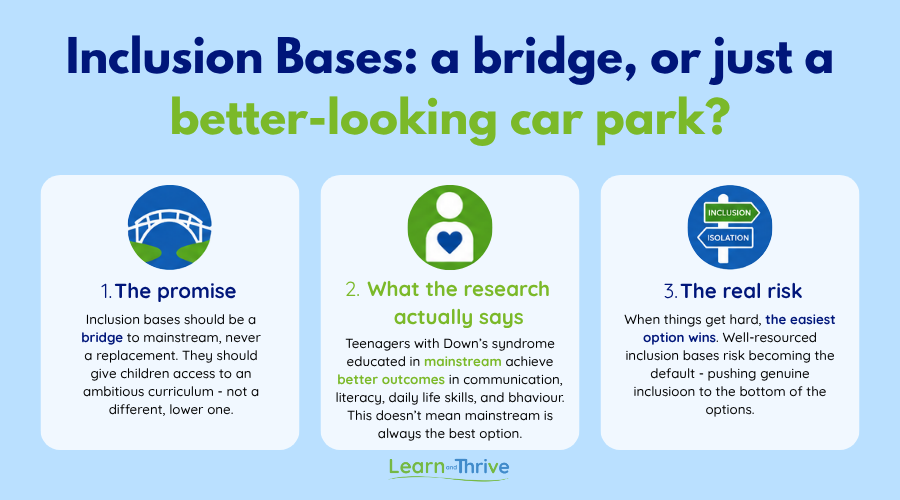
The DfE has just published its first-ever guidance on inclusion bases in mainstream schools. Now so far, I am loving the approach and the language. Bases should be a bridge to mainstream, not a replacement for it. They should never be used as a sanction. They should give children access to an ambitious curriculum. That all sounds pretty good to me. But as a professional and a parent I have heard this before.
My daughter has Down’s syndrome. Before she started secondary school, the school didn’t want her. Most parents who reach tribunal win — but getting there is exhausting, expensive and designed to wear you down. I know this all too well, having taken my own LA to tribunal more than once. So imagine everyone’s surprise — mine included — when, on this particular occasion, the LA and I rocked up to appeal together, jointly taking the school on, all the way to the Secretary of State. I can only assume the school’s legal team did a double take. The school lost.
When we arrived the teachers on the ground were brilliant. With support and guidance, they made it work. She became a beloved member of that school community — in every mainstream lesson until the end of Year 9, working at KS1 levels, progressing, happy. Properly included in every aspect of school life.
Now, this is a deeply personal experience, but I think it speaks to something much bigger. A school that fought to keep her out ended up including her brilliantly. Because inclusion isn’t about whether children can be included. It’s about whether the adults around them commit to making it happen.
In Year 10, that commitment quietly unravelled. The school would only offer her GCSEs in anything outside Maths, English and Science entry levels, which left gaps in her timetable. The school’s solution, and it seemed reasonable at the time, was to fill those hours with focused 1:1 time in the learning support base. But the decision wasn’t really about what was best for her. It was about how to deliver her lessons with the staff and space they had. Nobody sat down and asked: what does success look like for this young person? What does she need to thrive?
She stopped spending time with her peers. She gravitated to adults. She became unhappy. Her sense of belonging, which had kept her engaged and happy in a way that was, frankly, a triumph in itself, began to disappear. By the end of Year 10, her mainstream journey was over. And I don’t believe it had to be.
What happened wasn’t malicious. But it was a choice, and the school chose to work with what they had, rather than continue building new and better paths. The harder path would have been finding alternative qualifications she could work towards alongside her peers, adjusting the timetable to keep her as included as possible. That takes time, creativity and will. Sending her to learning support made sense when you view it as staffing and structure. So that’s what happened.
So, when this guidance landed, I read it carefully and I hope this makes things better for a whole range of children and young people. But wanting something to work and it actually working are two different things. Aspiration without safeguards gets eaten quickly by the practical realities of timetabling, staffing and resource. Our community has been on the wrong end of that gap too many times.
Here is what the research actually says.
Buckley, Bird, Sacks and Archer compared teenagers with Down’s syndrome educated in mainstream classrooms throughout their schooling with those educated in special schools. They measured speech and language, literacy, socialisation, daily living skills and behaviour. Before anyone says “well, the more able children went to mainstream” — the study accounted for that. School placement wasn’t determined by the children’s ability. It was determined by geography: which area you lived in and what the local educational policy was. The groups weren’t separated by ability. They were separated by postcode.
The mainstream group showed significantly better outcomes across most measures. Communication continued to improve through the teenage years for children in mainstream — it did not for those in special education. There were large, significant gains in expressive language and literacy. Mainstream-educated teenagers showed fewer behavioural difficulties. And when the researchers compared their findings with data from 13 years earlier, there had been no improvement at all in outcomes for children in special education over that entire period.
For our community, that is massive. That is the difference between a young person who can express themselves, advocate for themselves and shape their own future — and one who cannot.
Around 80% of children with Down’s syndrome attend mainstream primary schools. By secondary, that figure drops to 37%. More than half of children who started out included are no longer included by the time they reach secondary age. That drop isn’t explained by a sudden increase in the complexity of children’s needs. It’s explained by the fact that inclusion in secondary school is genuinely harder — the timetables, the specialist subjects, the staff confidence. And when it gets harder, the path of least resistance gets more attractive.
Right now, provision varies wildly. Some schools have nothing. Some have something that works. Most are somewhere in between, figuring it out as they go. From September, every school should have access to a funded, government-endorsed, properly kitted-out inclusion base. My question is this: will that be so tempting, so well-resourced, so officially sanctioned, that genuine full inclusion quietly gets pushed to the bottom of the options? Teachers are already stretched beyond what is reasonable and working in under-resourced classrooms. In that context, is full differentiation in a mainstream lesson a realistic ask — or will the inclusion base become the inevitable answer, not because anyone chose it deliberately, but because the system made it the easiest one to reach?
Not all children are the same. Not all SEND needs are the same.
And before anyone accuses me of being anti-inclusion base — I’m not. For some children, a well-resourced base could be transformational. Children with significant sensory processing needs. Children who are genuinely overwhelmed by the noise and pace of mainstream corridors and classrooms. Children for whom a calmer, adapted physical environment is not a compromise but a genuine enabler. For those children, this could change everything.
But for many children with Down’s syndrome (not all), or any child with a learning disability who with the right support can be genuinely included, sitting in a learning support base for three lessons a day because it is easier to manage their timetable — is not inclusion. That is not a bridge. That is a waiting room dressed up as provision.
If you are a SENCO or school leader reading this, ask yourself: is this placement for this child because the evidence says it will help them learn, connect and thrive? Or is it because it helps us manage the day?
These reforms risk putting every child with SEND into one of a small number of defined boxes (and don’t get me started on the tick-box nature of the Specialist Provision Packages in the new reforms — that is an article in itself). A tiered system of support sounds rational until you remember that the child in front of you is not a tier. They are a person, with a specific set of needs, a specific learning profile, and a specific right to be educated in the environment that will actually serve them best. Sometimes that is a mainstream classroom with proper differentiation. Sometimes it is a specialist school where the whole environment is built around them. A genuinely inclusive specialist placement can serve a child better than struggling to manage in a mainstream school.
What I will not accept as progress is a system where inclusion bases become the soft middle ground, where children who are too complex for mainstream convenience end up parked there not because it is right for them, but because there is simply no space in specialist settings.
The opportunity in front of us.
I think this guidance is a genuine step forward. I think the government wants it to mean something. I think the requirement for schools to publish an inclusion strategy by December 2026 is a real opportunity — not just a bureaucratic exercise but a chance to make real changes with thought and care.
What does inclusion actually look like in this school for the children who find it hardest?
Who is checking that the base is a bridge and not a destination?
Who is tracking whether the children who spend time there are moving back into mainstream lessons — or whether they are quietly spending more and more of their week there until everyone has forgotten that was never the plan?
I’m optimistic that this can be built right. I’ve seen what it looks like when it works — my daughter thrived in mainstream until the end of Year 9, and that was the right setting for her. It won’t be the right setting for every child. But for those it is, we owe them the commitment to make it happen properly, not just the appearance of it.
Not a better-resourced waiting room. Actual belonging in the right setting for them.
We have a window to build this properly. Let’s not waste it.
Johanna Aiyathurai is CEO and Education Lead at Learn and Thrive, a UK charity creating free specialist RSHE and early years resources for children and young people with Down’s syndrome and other learning disabilities. Learn and Thrive’s Learning for Life programme provides accessible RSE and PSHE resources designed for use in mainstream and specialist settings alike.
Research and policy sources:
Buckley S, Bird G, Sacks B, Archer T. A comparison of mainstream and special education for teenagers with Down syndrome: implications for parents and teachers. Down Syndrome Research and Practice. 2006;9(3):54-67.
Department for Education. Every Child Achieving and Thriving: Schools White Paper. February 2026.
Department for Education. Inclusion Bases in Schools. June 2026.