

Good Intentions Aren’t Enough: What the Evidence Really Says About SEN Interventions
I have a love-hate relationship with evidence-based practice in SEND. Love the principle. Hate how often it gets used as a stick to beat already-exhausted practitioners with. But something keeps popping up all over my LinkedIn feed, and it’s clearly dividing people. So, I thought we should get involved!.
10 Common SEN (Mis)Interventions by Peps Mccrea and Dr Jennifer Barker (Steplab / Ormiston Academies Trust, 2026) takes a hard, evidence-based look at ten interventions that have become near-universal fixtures in schools. Fidget spinners. Coloured overlays. Zones of Regulation. Sensory circuits. Weighted vests. Brain Gym. Learning styles. Mindfulness programmes. Working-memory training. Ear defenders.
The headline? For most of them, the evidence is weak, absent, or actively pointing the other way.
Now, I know a lot of people will be reading this with a big “yeah, but...” forming. It feels like it works. I’ve seen it work. But how much of that is confirmation bias? Seeing what we expect to see because we want it to be true? How much is the placebo effect? And how much is confident marketing dressed up as evidence? These are not comfortable questions. But they are the right ones.
Why this keeps happening
Mccrea and Barker are not unkind about it. They name the dynamic clearly: these interventions feel like they should work. They are visible, concrete, and something you can do immediately. Students often like them. Parents feel reassured. The marketing is confident.
Meanwhile the evidence for what actually supports effective inclusion is thinner than it should be, and harder to access than it needs to be. So we reach for what is in front of us.
There is also a cost to this that we do not talk about enough. Every minute a child spends on something that is not working is a minute they will never get back. A minute that could have been filled with something that actually made a difference to their learning, their confidence, their life. We talk about doing right by our children and young people. Continuing with an intervention that has no evidence behind it, without ever stopping to ask whether it is working, is not doing right by them. It is doing the opposite.
What the research actually shows
Let me pull out the key findings. Some of these will surprise you.
Fidget spinners
Now, lots of you aren’t going to like this one. Classroom studies found negative effects on attention and academic performance, regardless of whether a child had ADHD traits. And the harm was to the user, not their neighbours. The child we were trying to help was the one being hurt by it. If something is not helping the child it is meant for and is potentially pulling focus across the whole room, that is not a small thing. That is a whole class issue.
Coloured overlays and tinted lenses
Systematic reviews find no reliable benefit on reading. The apparent effects are largely placebo. Structured phonics teaching, by contrast, produced clear effects in the same research. And how many of us are now quietly wondering how we communicate that one to parents?
Zones of Regulation
This one is going to ruffle some feathers because it is absolutely everywhere. The most rigorous independent review found it does not meet the standards for an evidence-based practice. The two best randomised controlled trials found essentially null effects on self-regulation and behaviour. And I will be honest with you — Learning for Life uses colour-based emotion support in some of its resources, because we were bought into it too. That is exactly the point. We all were. Teaching children to recognise and manage their emotions is completely legitimate and genuinely important. The problem is not the goal. The problem is that this specific branded programme has not proven it delivers on that goal. There may be things you do within Zones that are helpful. But that is not the same as the programme working. And knowing that matters.
Universal mindfulness in schools
This is the one that genuinely alarmed me. The largest UK trial, 8,376 students across 84 secondary schools, found no benefit and possible harm. Students who started at higher risk of mental health problems showed worse outcomes after the intervention. The researchers concluded it may be contraindicated for the very students schools most want to help. We cannot unknow that. Now might be the time to review those provisions.
Weighted vests and blankets
A systematic review concluded they are not an evidence-based practice for autistic students. And as someone with a background in neuro-rehab physiotherapy, this is one I find genuinely tricky to align with, because in practice there are children who respond really well to deep pressure and children who do not. But here is the important distinction the paper makes, and it is one I think is really worth holding onto: clinically delivered pressure therapy and compression clothing recommended for a specific, assessed need is a different thing entirely. The issue is not deep pressure as a concept. The issue is a weighted blanket being pulled out by default because a child has an autism diagnosis. Every nervous system is different. That is exactly why individual assessment matters, and why diagnosis alone should never be the reason we reach for an intervention. So don’t go throwing all those weighted blankets and snakes out just yet. Just make sure you know why they are there.
Sensory circuits and sensory diets
This one I feel passionately about. Few positive effects in the small literature, and too thin to support as routine provision. But honestly, the research finding is almost secondary to what I see happening in practice. How many children are being funnelled into a sensory circuit at a set time because that is when it is running, not because that is what that child needs at that moment? How many schools started one in Year 1 and six years later nobody has stopped to ask whether it is still making a difference? Where is the review? Where is the individualised assessment? Where is the evidence that it is actually reducing that child’s neural load and helping them access learning? Too often it is ticked off a list and left to run on autopilot. And before anyone comes for me: clinic-based sensory integration therapy delivered by a trained occupational therapist, tailored to an individually assessed need, is a completely different thing with its own separate evidence base. That is not what we are talking about. We are talking about the generic circuit, rolled out by default, never reviewed, serving the timetable more than the child.
Learning styles and VAK matching
You will know this one even if you don’t know the name. The idea that children are either visual, auditory or kinaesthetic learners, and that if you match how you teach to their preferred style they will learn better. It is in CPD sessions, it is in planning formats, it has been taught to trainee teachers for decades. And it is the most thoroughly disproven of all ten. There is no evidence that matching instruction to a preferred style improves outcomes. None. Now, this is not the same as condition-specific learning profiles, and that distinction matters. We know, for example, that people with Down’s syndrome have stronger visual than auditory processing, stronger recognition than recall, and that visual supports and demonstration significantly improve learning outcomes. That is not a preference. That is a documented cognitive profile with a solid evidence base behind it. Adapting your teaching to that profile is not VAK matching. It is good, evidence-informed practice.
Brain Gym
The neuroscience framing is pseudoscientific. The authors acknowledge it is less common now. But if it is still happening in your school, it needs to stop.
Ear defenders
This one is different and I want to be really careful here because I can already see the misreading coming. Ear defenders are an accommodation, not an intervention. Auditory over-responsivity is a genuine and well-documented feature of autism and if a child needs them for a specific situation, use them. The issue is deploying them by default for every child with an autism diagnosis and never reviewing whether they are actually improving access to learning. The question is not “should this child ever wear ear defenders.” It is “when, why, and are they helping.”
The thread running through all ten
Here is what Mccrea and Barker say that I think is most important.
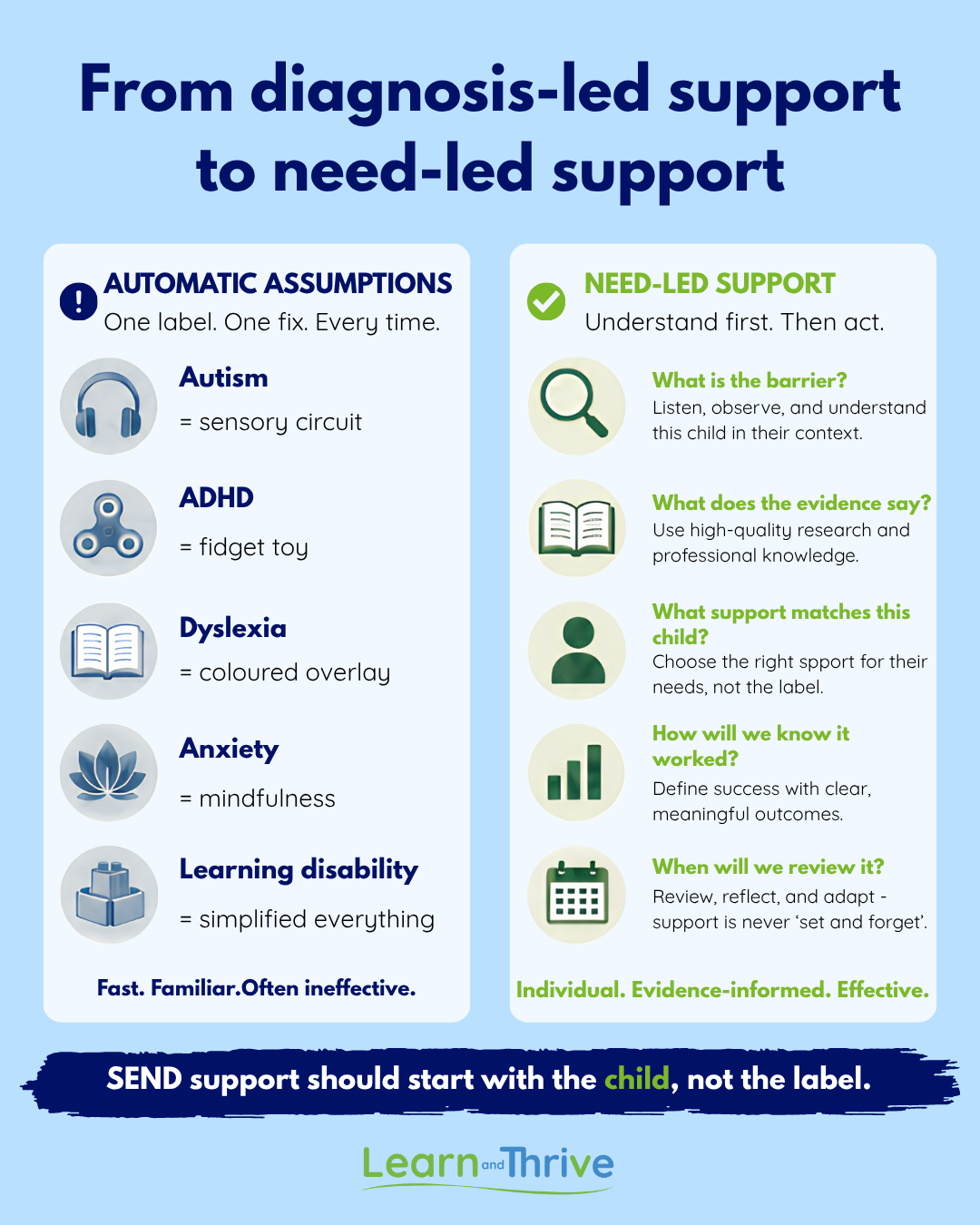
Support tends to be more effective when it follows from specific, assessed learning needs rather than from diagnostic labels.
Not “this child has autism, therefore sensory circuit.” But “what is the specific barrier this child is experiencing in this classroom, and what does the evidence say about removing it?”
At every review point, we should be asking:
Why do we do this?
Is it still working?
Is there something that would work better?
If we don’t we risk just blindly continuing to deliver provision that simply isn’t up to the grade, and that’s not helping anyone. Mccrea and Barker make the same point about EHCPs: many provisions are written as activities to deliver rather than outcomes to achieve, which makes it nearly impossible to ever conclude that an intervention is not working. If you cannot define what success looks like, you cannot know if you have got there.
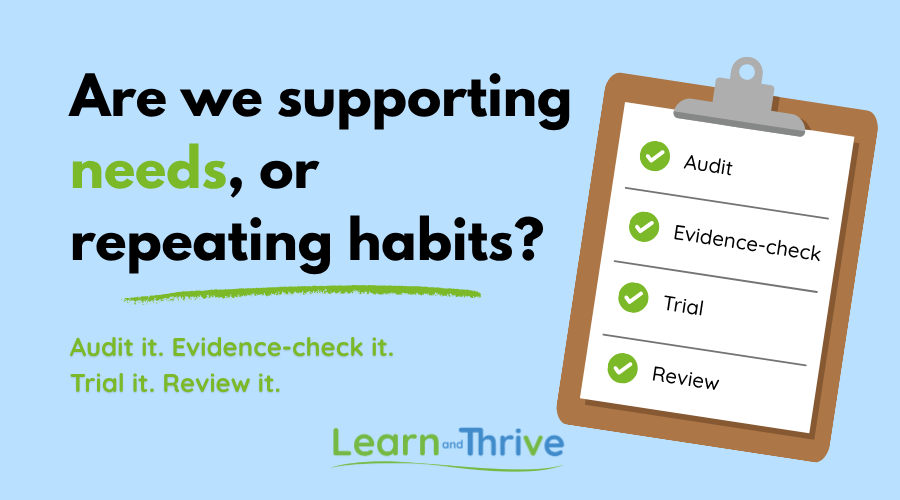
Their four recommended steps are: audit what you are running and why; strengthen universal provision; match support to assessed need, not diagnostic category; and if you use something with weak evidence, treat it as a time-limited trial with data.
So what does this practically mean for us?
The evidence base for SEND interventions is, in many areas, genuinely thin. And that is not only because some interventions do not work. It is also because the research has not been done.
Mccrea and Barker say this themselves. The evidence here is about average effects in mainstream classrooms. The picture looks different in specialist settings and for students with more profound or complex needs. This summary is not the last word for each student in front of you.
Running rigorous trials on interventions for learning disabled young people is hard and expensive. The specific groups, children with Down’s syndrome, with profound and multiple learning disabilities, with complex communication needs, are underrepresented in the research, or absent from it entirely. Many of the things that genuinely help this community have never been formally studied, not because they do not work, but because nobody has funded the research.
That does not mean anything goes. It does not mean we give ourselves a free pass. It means we have to be honest about what kind of evidence we are working from, use it thoughtfully, and review whether it is making a difference.
What this means for Learning for Life
Learning for Life, an RSHE offer developed specifically for learners with moderate to complex learning disabilities, does not have a randomised controlled trial behind it. We are a small charity. We do not have that budget, and we are not going to pretend otherwise.
What we do have is this.
Every module is built on the research that exists around what works pedagogically for learning disabled young people: explicit teaching, visual support, repetition, accessible language, parental and carer involvement. That is not us making it up as we go along. They are grounded principles with an evidence base, even if that base does not live in a trial of this specific programme.
We know this community faces significantly elevated risk of abuse and exploitation, but we also know the research says education is protective. We know that relationships and sex education, done well and accessibly, is not a curriculum nicety but a safeguarding essential. That is the research we build from.
We hear from schools and families. Consistently, specifically, across a wide range of settings. We know what is landing and what needs work, and we go back in when it does.
And critically: we review. We do not set resources and walk away. The assess, plan, do, review cycle is not something we ask schools to apply to our resources while exempting ourselves from it.
Is that the same as a large independent RCT? No. It is the appropriate, proportionate use of the evidence available, delivered by people with genuine expertise, to a community that mainstream programmes have consistently failed to serve.
So, where do we go from here?
Read the Steplab paper. Read it with an open heart and know that it is OK to change. If we stick with things simply because we have embedded them, we quickly get out of date. But if we are always asking why, always reviewing whether something is still working, always wondering whether there is a better way, then we are moving forward. We are dropping what is not serving our children and reaching for what does. That is not failure. That is brilliant practice. It means you are assessing, reflecting, and refusing to rely on a fixed list of this diagnosis equals this intervention, regardless of which child sits in front of you.
For each intervention you are running, ask three questions. What problem is it solving? What does the evidence say? And is it actually working for this child, right now? If the answer to that last question is “I don’t know,” that is your starting point. Not a source of shame. A reason to look again.
And if you work with young people with learning disabilities and you are not yet using Learning for Life for RSHE, have a look. Not because we have all the answers. Because we are asking the right questions, building carefully, and this community cannot afford another generation of provision that was well-intentioned but not good enough.
Johanna Aiyathurai is the CEO and Education Lead at Learn and Thrive, a UK national charity creating specialist RSHE resources for children and young people with Down’s syndrome and other learning disabilities. She is also a mum to a young person with Down’s syndrome, a former physiotherapist specialising in neuro-rehabilitation, and the founder of two disability charities.
Reference
Mccrea, P. and Barker, J. (2026) 10 Common SEN (Mis)Interventions: An Evidence Summary of Ten Popular Approaches in Mainstream Classrooms. Steplab / Ormiston Academies Trust. Version 1.0, May 2026.