

SEND Reforms… What You Need To Know
Right, now it’s time for the breakdown. Jo shared her initial thoughts about the SEND Reform from yesterday’s (23rd Feb) White Paper, so now we are here to break down exactly what the proposed changes are. No opinions, just facts.
Don’t forget - these changes are simply proposals and nothing changes until the consultation and parliamentary debates have completed and it’s passed into law. This means that any attempt by schools, councils, or LAs to use these reform proposals to make changes now shouldn’t be happening. The earliest point these changes will come into effect will be 2028/9.
Let’s get into it. We’ll start with a quick overview. This blog by no means covers every single detail, but we’ve picked some of the most impactful (and talked about) elements of the Paper.
Proposed Changes
> Support now divided into 4 layers: Universal, Targeted, Targeted Plus, and Specialist
> EHCPs now only available in the Specialist tier of support (although EHCPs will remain in place to the age of 25)
> New Specialist Provision Packages (SPPs) which determines who is eligible for an EHCP
> Introduction of Individual Support Plans (ISPs) for those who no longer qualify for EHCPs - all children with SEND will have a right to an ISP
> Support Bases and Specialist Bases
> £1.6billion Inclusive Mainstream Fund
> £1.8billion ‘Experts at Hand’ service
> £200million for universal SEND teacher training and a new National Inclusion Standard
> £3billion for 50,000 new SEND school places
> Special school curriculum review - working with experts to ensure “good curriculum practice”
> Update of the existing SEND Code of Practice through consultation
> Cap on fees charged by private special schools
You can click on each of the links above for more detail. Everything is interlinked, so we’ve made sure to include all the links within each section too, so you can jump about as you need.
Key Themes
There are a few stand out points from across the White Paper:
Significant focus on mainstream - adding more support and funding to mainstream schools to improve specialist provision, both through teacher training and targeted support for students. The legal principle of “presumption to mainstream” is being maintained.
Shift away from EHCPs - introduction of ISPs, and increased specialist support across all four layers of support, including Universal.
Aiming to standardise support - SPPs will use 7 different categories of SEND to decide what the Package of support individuals should be provided with
Layered Support
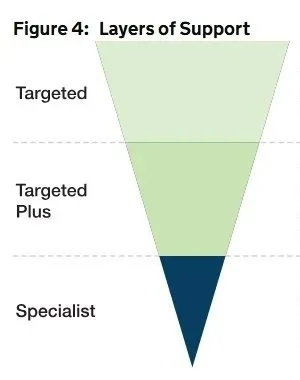
There are going to be 4 layers of support in total: Universal (not shown in this image, but it would sit on the top!), Targeted, Targeted Plus, and Specialist.
Universal: high-quality, inclusive teaching with reasonable adjustment. This is what’s currently in place.
Targeted: learners get an Individual Support Plan (ISP), created by the setting with input from parents.
Targeted Plus: learners get an ISP created by the setting with input from parents, education and health professionals. Support may include access to a ‘Support Base’.
Specialist: these learners will get EHCPs. The individuals who get EHCPs is dependent on whether they require provision from one of the new Specialist Provision Packages (SPPs). Support may also include delivery through a ‘Specialist Base’.
What are ‘Support Bases’ and ‘Specialist Bases’?
These ‘Inclusion Bases’ are specialist placements for within mainstream schools. These do currently exist, but under different names, like resources provision and units. In the proposals, Support Bases are funded by schools or Multi-Academy Trusts (MATs), and Specialist Bases are LA funded.
Rebranding these provisions won’t avoid many SEND parents and educators understanding what they are, which is provision outside of mainstream lessons. They are already controversial, and continue to be so in these proposals.
Individual Support Plans (ISPs)
For those in the Targeted and Targeted Plus layers of support, they will receive digital Individual Support Plans (ISPs). From what we can tell so far, these are similar to EHCPs, and more in line with Individual Education Plans. These were in place for those with SEND without EHCPs pre-2014. So, in a sense, the proposals are bringing back this ‘intermediate’ level of support.
Settings will have a legal duty to produce a digital ISP for all children in these two support layers. They will be required to:
Identify any barriers to learning
Set out agreed provision
Review and monitor progress
Follow all reasonable adjustment guidance
We will have to follow the consultation and changes to the proposal to see how this plays out. These requirements will seem familiar to parents and SEND educators, as these are already in place now. But these proposals would make this statutory.
This could mean they are much better reviewed and monitored in the long run, but what’s not completely clear is how much they can be enforced legally, and how easily they can be challenged. This is something we expect to see come up a lot in the current consultation.
EHCPs
Proposed to only be a part of the Specialist layer of support, EHCPs do have significant changes coming in some aspects. While the contents of EHCPs aren’t necessarily being challenged, the number and need of the children who will receive them will be limited. This is where the Specialist Provision Packages (SPPs) come in. The proposal puts the SPPs into place to act as ‘eligibility criteria’ to decide who gets EHCPs.
Admittedly, this is one of the less popular proposals. This is because EHCPs provide legally enforceable support, and so we can’t quite tell how those without EHCPs will fare if problems with provision arise. It might also mean that EHCPs become much less flexible. But all of this remains to be seen, and, again, will definitely be a point of contention at consultation.
Specialist Provision Packages (SPPs)
So what are the criteria attached to these Specialist Packages? We’re providing a simple overview here of the key SPPs, simply giving you the categories, with a bit of detail of what these actually mean in the White Paper’s definition.
Profound and Multiple Learning Disabilities (PMLD)
Multiple learning disabilities - including profound cognitive impairment, significant communication difficulty, physical disability, sensory processing differences, and more. This is a term most of us are already familiar with.
Significant Executive Function (currently severe learning difficulties)
Severe and permanent global learning disability, or lifelong speech and language disorder, and these impact areas of speech, language, and communication, executive function, social and emotional, motor and sensory development.
Complex Executive Function and Communication
An emerging profile. A “significant permanent learning disability affecting some, or all, areas of speech, language and communication, executive function, social and emotional, motor skills and sensory development. Children who need this package often manifest with behaviour that challenges.”
Social and Emotional Development - Externalising Behaviour
For those whose “social and emotional needs manifest in behaviour that challenges”. Includes: autism, ADHD, language disorders. This SPP also notes that health services should be used to address wider mental health needs for this group.
Social and Emotional Development - Internalising Behaviour
Similar to the above, but focussed on ‘internalising behaviour’. Those “whose social and emotional needs manifest as withdrawal, disengagement or ‘shut down”.
Sensory Impairment
Deaf, visually impaired, or multi-sensory impaired individuals.
Physical Disability (without significant learning difficulties)
Individuals with physical disabilities. Crucially, those who can access the mainstream curriculum. This means their EHCPs would centre on physiotherapy, OT, adaptations to support them in access to the school itself, it’s curriculum, and in their wellbeing.
For parents in particular, the concern here is the reduced individualisation of EHCPs through using these SPPs, where the focus on these categories ignores individual need. But these could be changes and adapted during the consultation and debate process, so how they come out in the wash remains to be seen.
Inclusive Mainstream Fund
The Inclusive Mainstream Fund is a new, additional piece of funding to support SEND in mainstream schools. On top of existing core SEND funding, this should help support targeted and small group interventions for children with additional needs. As always, additional funding is welcome.
'Experts at Hand' Service
To increase specialist support in mainstream settings, this new service is proposed. The new ‘Experts at Hand’ service is aiming to ensure that there is sufficient access to specialists in every area. This is regardless of EHCP status. So for students with and without both EHCPs and ISPs, this service will be available.
This service will be overseen by LAs, and will include speech and language, educational psychology, and occupational health. Around £1.8 billion will be given to local areas to create this service, and will be based on the needs of education settings and student in these areas.
In theory, this support will mitigate some of the changes students might face through lack of an EHCP.
Universal SEND Teacher Training
£200 million of funding is going directly towards a new training programme for teachers. This aims to ensure that “every teacher knows how to support every child in their classroom and give them the help they need - not just the specialist staff”.
National Inclusion Standard
The NIS will create an evidence-based, digital hub of resources to support settings to ensure learners’ needs are met.
These are created to set “clear, evidence-based” guidance, to be used in the Universal offer. There will also be guidance included on what the further layers of support should look like.
The development of the NIS will cost £15 million, and will be overseen by an independent expert panel (but we don’t know the composition of this panel yet).
Additional Reforms and Veiled Changes
Also within the Schools White Paper and in new national targets:
Encouragement for schools to join trusts (although no incentives or enforcement)
Regional improvement programmes - Mission North East and Mission Coastal
Push for better academic standards, with children leaving secondary school with an average of grade 5 or higher across GCSEs
Including halving the disadvantage gap by supporting students from low income backgrounds to achieve approximately one full grade higher in each GCSE than is the current outcome
Increasing pupils’ sense of belonging and engagement at school
Changes that are less ‘front-and-centre’ (and are likely to be heavily challenged):
A tailored list of settings for EHCP placements, where LAs provide the list based on where is capable of delivering the student’s SPP, rather than any suitable school as it standard currently
SEND Tribunals aren’t mentioned as a legal backstop for ISPs, so it’s unclear how these will be legally enforced or challenged, even if they are made statutory
Sources:
SEND - Putting children and young people first - version for children and young people
Schools white paper: What parents need to know about changes to the SEND system – The Education Hub
How the SEND White Paper 2026 Could Reshape Education Care Plans by 2035?
SEND White Paper 2026: What It Means for Your School
Major changes to SEND support in schools announced – all you need to know | The Independent
What the Schools White Paper Could Mean for Children With SEND – SEND Vision