

It’s only been a few hours: first thoughts on the SEND reform proposals
“Every Child Achieving and Thriving” - A quick, plain‑English recap of what’s being proposed
First, a big caveat: this is early days. This is a policy paper plus a consultation. It isn’t law yet, and the detail that matters most for families and schools will depend on what eventually gets written into legislation, regulations, and the SEND Code of Practice.
That said, the direction of travel is clear. The proposals describe a redesigned SEND “ladder” of support in mainstream settings, with EHCPs used for a narrower group of children and young people than they often are now.
The new levels of support: Universal, Targeted, Targeted Plus, Specialist
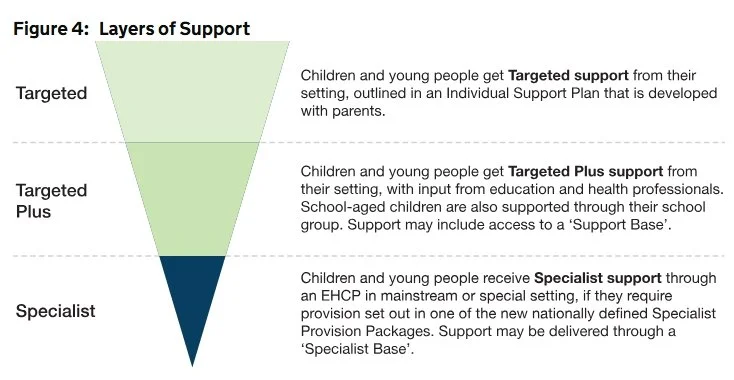
Image of the levels of support.
Here’s the simplest way I’ve made sense of it:
Universal (for everyone)
This is the “every day” offer: quality-first teaching, inclusive classroom practice, reasonable adjustments, behaviour support, and early identification. In theory, Universal becomes stronger and more consistent everywhere.
Targeted (extra help, still school-led)
This is where a child needs support beyond the Universal offer: small-group interventions, structured programmes, targeted adjustments, or specific strategies (for example, literacy support, sensory supports, classroom communication strategies).
The key idea is: you shouldn’t need an EHCP to access sensible, evidence-based support.
Targeted Plus (school-led + specialist input)
This is Targeted support with more multi-agency input: access to specialist professionals (for example, speech and language therapy, educational psychology, occupational therapy) to help a mainstream setting get it right without having to “go statutory” first.
Specialist (complex needs; specialist provision packages; EHCP for those who meet the threshold)
This is where the proposals say an EHCP would be used—linked to nationally defined Specialist Provision Packages. The consultation suggests the system would decide the child’s “package” and then decide placement, and only after those decisions would the EHCP be written.
The new “working document”: the Individual Support Plan (ISP)
The proposal puts a digital Individual Support Plan (ISP) at the heart of day-to-day provision. The ISP is meant to capture what support is actually happening in school/college/early years, how it’s being reviewed, and what outcomes are being pursued. It’s presented as a more practical, less legalistic plan that follows the child.
That sounds sensible on paper, and there is something appealing about reducing the current “fight for an EHCP just to get help” dynamic.
But (and this is where my concerns start) the power and enforceability of that ISP is still very unclear.
My main concerns after a first read
These are my immediate “red flag” areas — not final conclusions, but the things that leapt out at me on my first read through.
Individualised needs versus “Package first, plan later”
The proposal says, in essence: the Specialist Provision Package and placement decisions come first, then the EHCP is written afterwards.
My worry is not that packages exist. Standardised frameworks can improve consistency and reduce postcode variation if they are carefully written, evidence‑based, and updated.
My worry is how the child’s individuality survives a “package-first” model in practice.
Because this can easily become:
You get “slotted into a box”.
The system decides what that box usually gets.
Anything that requires a more individual approach gets set aside.
Importantly, will this be the rise of; up to, access to, benefit from. All those words we see slipped into plans now to make a nonsense of the provision in them. Up to 10 sessions, can actually be 0 sessions!
We risk erasing specific, specialist needs that absolutely matter.
A real-world example: a child with Down’s syndrome may benefit from speech and language therapy, but not all speech and language therapy is equal. Some children need a therapist who understands the Down’s syndrome learning profile and uses approaches with a strong evidence base for that profile. If a ‘Package’ assumes generic SLT input is sufficient, a child could “technically” be receiving SLT, while not receiving the right SLT.
So my big question is:
How will Packages allow genuine personalisation — especially where specialist knowledge, training, or a particular therapy approach is critical?
If the answer is “the ISP can individualise it”, then we need to know:
Who decides what goes in the ISP when school capacity is tight?
What happens if parents disagree with what the setting says it can provide?
What recourse exists if the ISP becomes a “we’ll do our best” document rather than a “this will happen” document?
Review and accountability: does “reviewed by the setting” mean “controlled by the setting”?
Another section says day-to-day provision in the ISP would be reviewed regularly by the setting, while EHCPs would be reviewed by the LA at key stage transitions (with annual reviews retained in early years and post‑16).
On the upside: regular review embedded in school life is what many families want — less waiting, less bureaucracy, more responsiveness. It can mean a more responsive and relevant document for everyone.
On the downside: this shifts huge power to the setting, and I can see a risk that some children get stuck with:
what the school says it can deliver,
rather than what the child actually needs.
The reality of staffing, training, time, competing pressures, specialist knowledge gaps, and budgets, puts real access to support when needed in question.
So my practical accountability questions are:
What legal weight does an ISP have?
Is it enforceable in any meaningful sense, or is it essentially a “record of support we hope to offer”?
Who is the duty‑holder for ISP delivery?
Is it the school? the trust? the LA? (The consultation is much clearer about shifting EHCP educational delivery to settings, but far less clear about ISP enforceability.)
What happens when the setting and the family disagree?
Is there mediation? an independent review? a right of appeal? a clear timetable to resolve it?
Without strong answers, the “regular ISP review” could become a polite process for documenting limitations rather than meeting needs.
Parental preference and placements: the “list” model
This is the part that made my stomach drop.
The proposal is that LAs would give parents and young people a list of settings able to deliver the relevant Specialist Provision Package, and parents can choose from the list or request an alternative. The consultation also says placement decisions would give more weight to effectiveness, value for money, fairness, and the needs of other children — and that Tribunals would no longer “name” placements in the same way.
I understand the policy intention: LAs need to manage finite capacity, stop runaway costs, and avoid a system where the loudest or most legally resourced wins.
But the risk is obvious:
The LA controls the list.
The list may be small in a small authority (or where specialist capacity is limited), leading to poor choice and families being forced to accept poor provision due to LA commissioning decisions.
“Request an alternative” may exist on paper, but be very hard to win in practice — especially if “value for money” and system-wide impact are weighted more strongly than they are now.
And there is an additional logical trap if the system works like this:
Decide the Package first (in theory, objectively).
Identify settings “able to deliver the Package”.
Offer parents a list.
If parents argue none of the list actually meets the child’s needs, the LA can respond: “But they can deliver the Package.”
That could create a new kind of postcode lottery: not whether you can get an EHCP, but whether the Package framework and the LA’s list genuinely reflect what your child needs and what is available locally. Will this end up being a situation where LA’s go through what they have, badge it up according to package and voilà, you get the provision that is badged with your package. Conversation over.
So my questions here are blunt:
How will “able to deliver the Package” be tested and evidenced?
Is this based on inspection data, staffing qualifications, outcomes, specialist training, real capacity, and actual provision quality — or just a statement that they “offer the package”?
What protections exist for children whose needs sit awkwardly between Packages, or who need unusual combinations of expertise?
If the Tribunal can’t effectively secure a named placement, what is the real remedy when an LA’s list is inadequate?
How will transport and distance be handled, especially if “local” capacity is not actually there?
What this could mean in practice for teachers and SENCOs
Even if you agree with the direction of travel, the day-to-day implications for schools and colleges are big.
If ISPs become routine and statutory:
Workload and quality control become central. A well-written ISP could be transformative. A rushed ISP could become meaningless paperwork and fuel disputes.
Training and specialist knowledge matter more than ever — because the system is explicitly trying to solve problems earlier, in mainstream, without the EHCP route.
Settings may become the front-line duty-holder for delivery and accountability, potentially including EHCP educational delivery if the proposals become law. That’s a major shift in legal and practical responsibility.
For teachers, this could feel like either:
genuine empowerment with proper support (specialist input “at hand”), or
being handed responsibility without the staffing, training, time and specialist access to deliver it. Now the proposals do include a big push for training and skills, as well as the recruitment of specialists so over time this should feel better, if delivered right.
The questions I want answered next
These are the “I need to see this in writing before I can relax” questions. If you’re reading as a parent, SENCO, or leader, these might be helpful prompts for your own consultation response:
What will a package look like? How many “up to’s” are in there.
How will the system protect niche or diagnosis-specific expertise (for example, evidence-based approaches for Down’s syndrome, autism, deafness, visual impairment, complex AAC needs)?
What is the legal status of an ISP?
Is it enforceable? What minimum content must it include? What timescales apply? What happens if it isn’t delivered? They say timescales will be reduced, but how will LA’s and education settings be held to account.
What is the dispute route about an ISP?
Complaints? mediation? independent review? Tribunal? (Right now, this feels under-specified.) They talk of working with schools to improve complaint pathways, but this doesn’t feel like the external accountability families were begging for.
Placement rights: what does “request an alternative setting” really mean in practice?
What evidence test must parents meet if the LA list is inadequate?
How will the system prevent “paper compliance” — settings claiming they can deliver Packages in theory, without the staffing and expertise in reality?
Transport and proximity: how do you guarantee truly local provision when specialist capacity is uneven?
Closing thoughts: Something had to change and there is no perfect solution but…..
I can absolutely see the aim: lower conflict, earlier support, less bureaucracy, more inclusion, and fewer families forced into legal battles just to get basics in place.
But the proposals carry real risks:
that individual needs become secondary to category-based Packages,
that school capacity quietly defines “need”,
and that parental placement rights weaken in practice, particularly in areas with limited specialist provision.
It’s only been hours. These are first thoughts. I’ll be reading more closely and digging into the detail.
If you’re a parent or educator, this is the moment to ask precise questions and to start to line up real children in your head. Where are the gaps?, how would the child you support fare in this system?
Because if the next system is built without those children in mind, they’re exactly the ones who will be told they “fit the package” — while still falling through the gaps.
Johanna Aiyathurai is CEO and Education Lead at Learn and Thrive. She herself has a teenage daughter, who has Down’s syndrome. She is also governor at a special school in Kent. Her experience across her professional life and her parenting means this White Paper is truly important across her life.