

Preparing for the 2026 RSHE changes
Why the new guidance creates an opportunity to strengthen SEND provision and whole-school consistency.
From September 2026, schools will be expected to update their RSHE curriculum and ensure they have an up-to-date written policy for relationships education or, where applicable, relationships and sex education (RSE).
These requirements sit within the wider statutory framework that places relationships education in primary schools and relationships and sex education alongside health education in secondary schools.
High-quality RSHE plays an important role in preparing pupils for adult life. The statutory guidance highlights its contribution to pupils’ social, moral, mental and physical development, while also recognising the role relationships education plays in safeguarding. Through this curriculum, pupils learn about healthy relationships, personal boundaries and where to seek help if something does not feel right.
In recent years, schools have also been responding to new challenges affecting young people, particularly within online environments. The updated guidance reflects this changing landscape by strengthening expectations around teaching digital safety, respectful relationships and wellbeing.
For many schools, this review will involve refining existing provision rather than starting again. However, it also provides an opportunity to ensure that the curriculum is accessible to all learners, including those with special educational needs and disabilities (SEND).
What’s Changed
The revised guidance reflects the realities young people encounter as they grow up today. Alongside more sensitive topics, it encourages schools to build pupils’ knowledge, skills and confidence so that they can develop healthy relationships and take responsibility for their own wellbeing.
In primary schools
The updated guidance gives greater emphasis to several areas of learning. These include developing a stronger understanding of online safety and digital wellbeing, using accurate language when learning about the body — including correct terminology for genitalia — and teaching practical personal safety in everyday environments such as around water, roads and railways. The guidance also highlights the importance of supporting children to understand experiences such as change and loss, including bereavement, while continuing to build communication skills, assertiveness and the confidence to express their own needs and personal boundaries.
In secondary schools
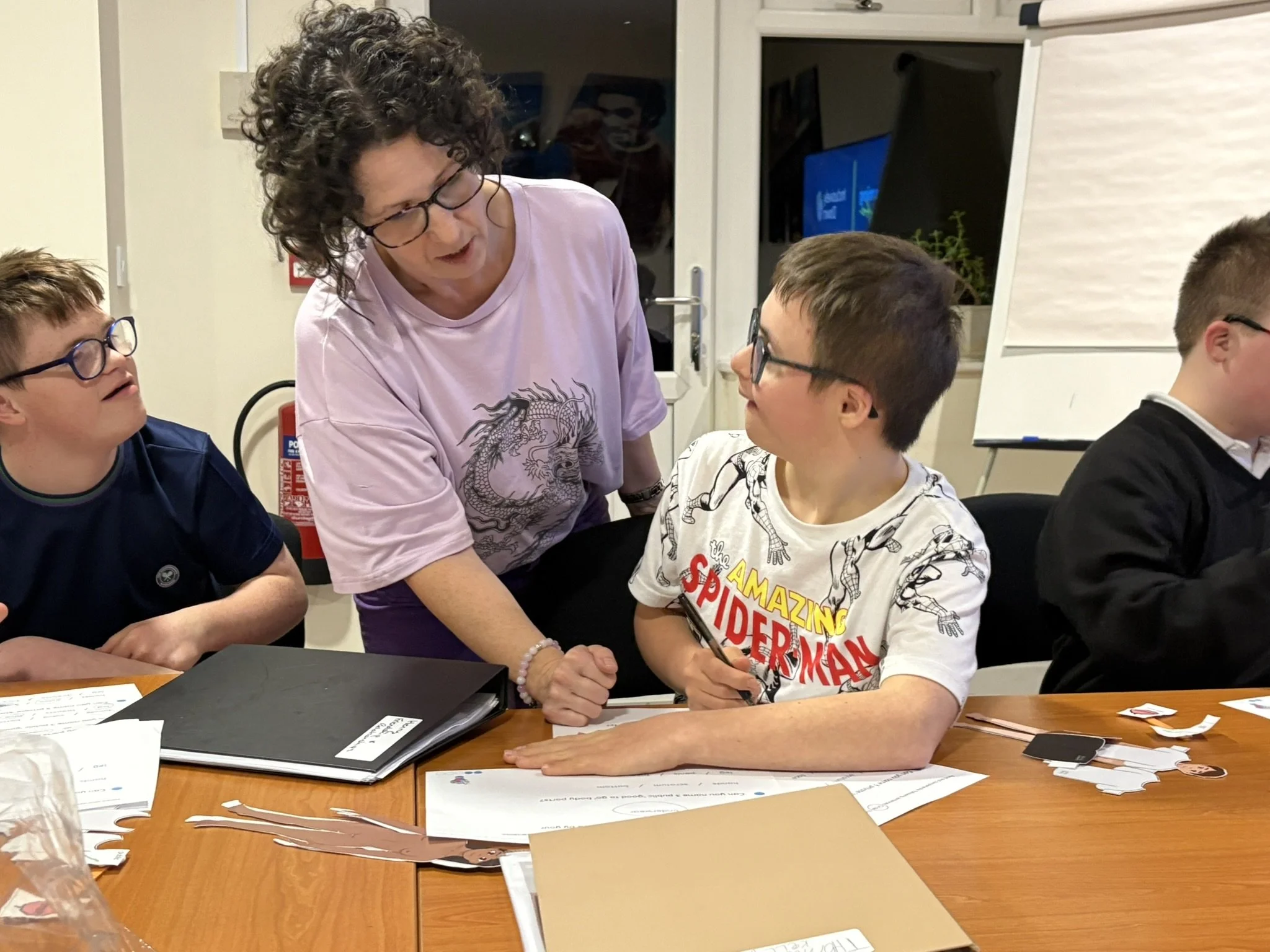
Thomas and Rhoda working through the Growing Up and Keeping Safe series at Down’s Syndrome Manchester.
A much stronger focus on tackling misogyny, incel culture and the impact on woman and girls, as well as on how this can negatively affect boys. Pupils explore topics such as AI, online behaviour, the influence of media and pornography. There is also a focus placed on teaching more about menstruation and gynaecological health, including menopause.
Schools are also encouraged to address harmful stereotypes and behaviours that can shape young people’s attitudes towards relationships. Alongside this, pupils should learn about how to access appropriate support and healthcare services when they need them.
Taken together, these expectations aim to ensure that young people leave school with the confidence and skills to access healthcare services when they need them.
A whole-school approach
The updated guidance encourages schools to develop RSHE as part of a wider whole-school approach to wellbeing and respectful relationships. In practice, this means ensuring the curriculum sits alongside safeguarding procedures, behaviour policies and the wider culture of the school so that pupils experience consistent messages about relationships, safety and respect.
Consultation and collaboration are also central to this process. Schools are expected to engage with their communities when developing RSHE policies and provision, ensuring that the curriculum reflects the needs of pupils and is delivered by staff who feel confident and well supported.
In practice, this can look like:
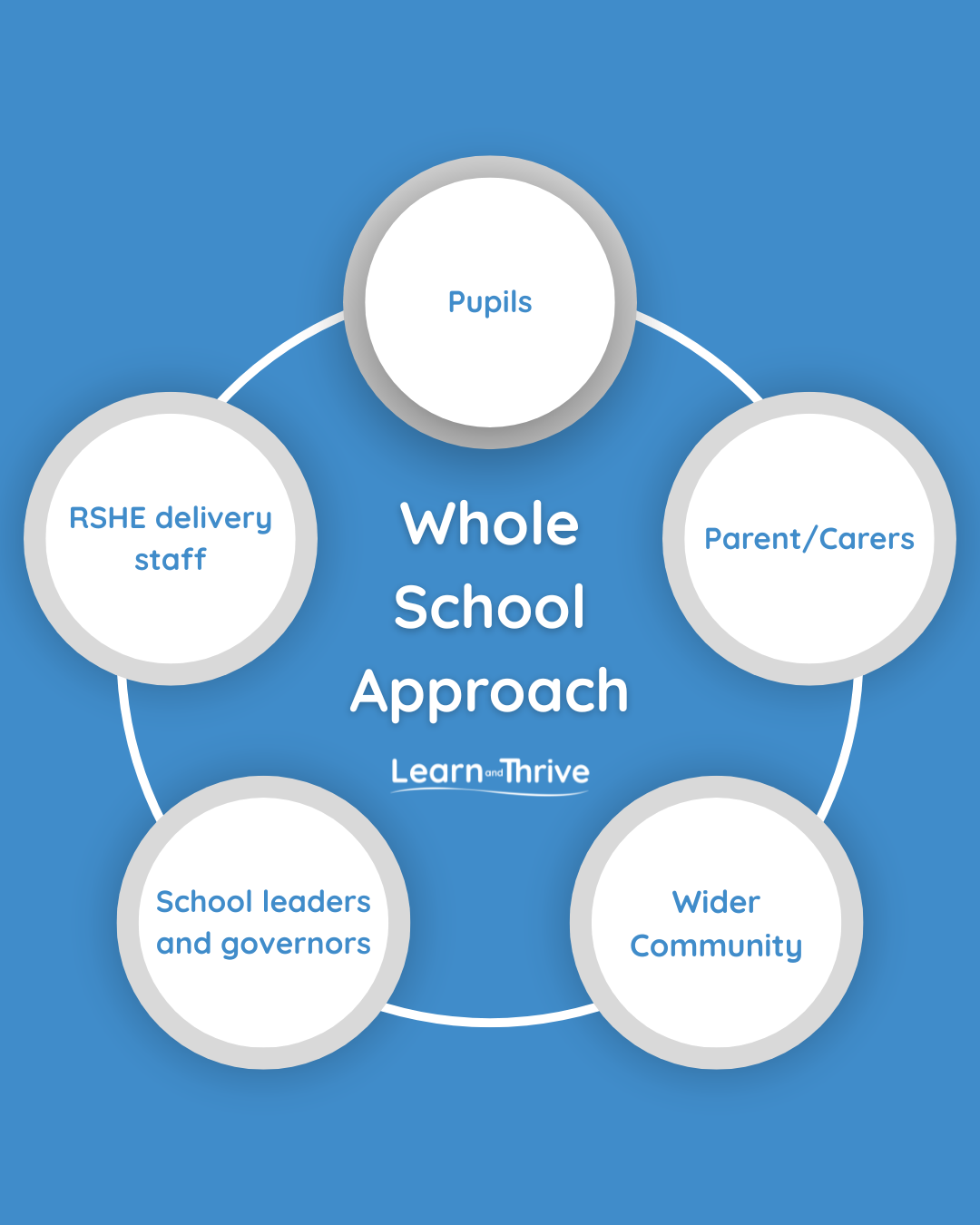
Image describing the whole school approach. The 5 key stakeholders are all in a circle around the words ‘Whole School Approach’.
For pupils
Meaningful involvement in shaping learning, helping ensure the curriculum feels relevant, inclusive and engaging.
For parents and carer
Clear communication and transparency about what is being taught, alongside opportunities to understand the materials and approaches being used. This should be two-way communication. Without input from parents and carers on what daily life looks like for your leaner, you can’t possibly tailor a curriculum that works outside of the school gates.
For the wider community
Working with local partners and organisations where appropriate to understand local issues and strengthen provision.
For staff delivering RSHE
Ensuring teachers have the knowledge, training and confidence needed to create safe and supportive learning environments.
For school leaders and governors
Making sure RSHE policies are in place, consulting with stakeholders, and reviewing how the curriculum supports pupils’ wellbeing and development.
For many schools, the challenge is not whether RSHE is taught, but whether the language and expectations around relationships and safety are consistent enough across the school for pupils to truly understand them.
This is where structured frameworks can be particularly helpful.
At Learn and Thrive, our Learning for Life framework was developed with this in mind. The programme supports schools to teach relationships, personal safety and independence skills through structured lessons, visual supports and shared language that can be reinforced across classrooms and pastoral settings. For learners with Down’s syndrome and other learning difficulties, this consistency can make a significant difference in helping them understand and apply what they have learned.
Ensuring RSHE is accessible for SEND learners
The statutory guidance makes clear that RSHE must be accessible to all pupils, including those with SEND. Schools are expected to ensure teaching is appropriately differentiated so that every pupil can access the curriculum.
In reality, this often means thinking carefully about how concepts are explained and reinforced. Relationships, boundaries and consent can be complex ideas, particularly for learners who benefit from more structured teaching approaches.
Visual supports, repeated language and opportunities to revisit concepts over time can help pupils develop a clearer understanding. Real-life examples and practical scenarios can also support learners in connecting the curriculum to their own experiences.
When RSHE is inaccessible, the pupils who most need clear teaching about relationships, boundaries, and safety are often the ones least able to access it.
Accessible teaching therefore becomes an important part of safeguarding. When pupils understand personal boundaries, consent and where to seek support, they are better equipped to recognise risk and respond appropriately.
Over recent years, organisations such as Learn and Thrive have increasingly worked alongside schools, SEND specialists and families to develop approaches that make RSHE more accessible for learners with learning difficulties. This growing focus reflects a wider recognition across the sector that relationships education must work for all pupils if it is to fulfil its safeguarding purpose.
Preparing for implementation
With the updated expectations coming into effect in 2026, many schools are beginning to review their current RSHE provision.
This may involve evaluating existing PSHE programmes to ensure that the curriculum reflects the revised guidance and that all required topics are covered appropriately. Schools will also need to review their written RSHE policies to ensure they remain compliant with statutory requirements.
For many RSHE leads, this review process comes alongside an already full curriculum and competing priorities across the school year. Finding approaches that support consistency without adding unnecessary complexity will be an important part of successful implementation.
Alongside curriculum review, schools may also wish to consider the professional development available for staff delivering RSHE. Providing teachers with appropriate resources and support can help ensure confident and effective delivery.
Looking ahead
The updated RSHE guidance recognises that young people are growing up in a rapidly changing social environment.
For schools, this review process provides an opportunity not only to update curriculum content but also to strengthen how relationships education is delivered across the wider school community.
By embedding shared language, ensuring accessibility for SEND learners and building strong partnerships with families, schools can help ensure RSHE provision remains meaningful and effective for all pupils.
When delivered thoughtfully, RSHE continues to play a vital role in helping young people understand relationships, recognise risk and develop the skills they need to thrive.