

Consent & Decisions for People with Learning Disabilities
Allowing our children and young people to make their own choices in life is key to their independence. Understanding consent, and their own rights to their own decisions, is critical.
That’s why we’re creating the new Consent series, alongside Claire Lightley from Bodysense Education, and Mel Gadd from the Sex Education Company. Both have worked with young people and adults with learning disabilities and SEND, supporting their ability to consent and make their own decisions throughout their lives. Both Claire and Mel make impact young people and adults with learning disabilities in so many ways, supporting them to live safer, more independent, and more connected lives - totally in line with our mission here at Learn and Thrive.
Empowerment comes through education - but we need to start with a bit of background.
Consent in the Law
Everyone has a right to make their own decisions, with some exceptions under 16 or 18 where parent/carers are involved. But the assumption that everyone can make their own decisions applies to everyone in the first instance.
For many of the learners we support with our resources, they will be covered by the Mental Capacity Act. We will talk about this a bit more later in the blog.
The assumption that everyone can make their own decisions means we must seek consent. The word ‘consent’ is so often tied up with the focus of teaching about sex (we all know the Tea video!). But consent is about so much more - every single day we give and refuse consent, and we receive or are denied consent by others. We don’t always see it that way, because it seems like a simple yes or no (even to the question: ‘do you want a cup of tea?’).
So the idea of consent, while often taught in schools around sex and relationships, is really in our every day lives more than we realise. Consent in sex and relationships is vital. But understanding consent in its broadest context is the key to understanding consent in a sexual context as well.
And for a young person or adult with a learning disability, consent (or a lack of consent) shows up every day, those small moments of consent matter, but they are too often stolen away. Let’s meet Steven.
Steven is 24, and he has a learning disability. He lives in a supported living setting, and has a care worker, Matt, who helps him to do certain things.
First thing in the morning, he wakes up, and Matt asks Steven what he wants to wear today. Matt helps Steven to shower, and get dressed into the clothes he picked out. They go to breakfast, and Steven gets to pick what he would like for breakfast. Today, they are planning on going into town to go to the shops. Matt asks Steven if he wants to walk into town, or get the bus.
We won’t go into every step of Steven’s day. But you can see that Steven is making choices, and giving consent throughout the course of his day, about clothing choices, personal care, and what he wants to eat. A typical adult would be making each of the same decisions, without ever needing to seek or give consent from a supporting person.
With this increased dependence on others to make choices and decisions comes a significant increase in vulnerability, so we must equip people with the key skills to be as independent as they can and give or seek consent. They need to:
Know when a decision is theirs to make
How to give or refuse consent - and be assertive!
Understand their boundaries and decisions should be respected, and they should do the same for others
But not all decisions in Steven’s life are that simple. Because Steven has a learning disability, he is covered by the Mental Capacity Act.
The Mental Capacity Act
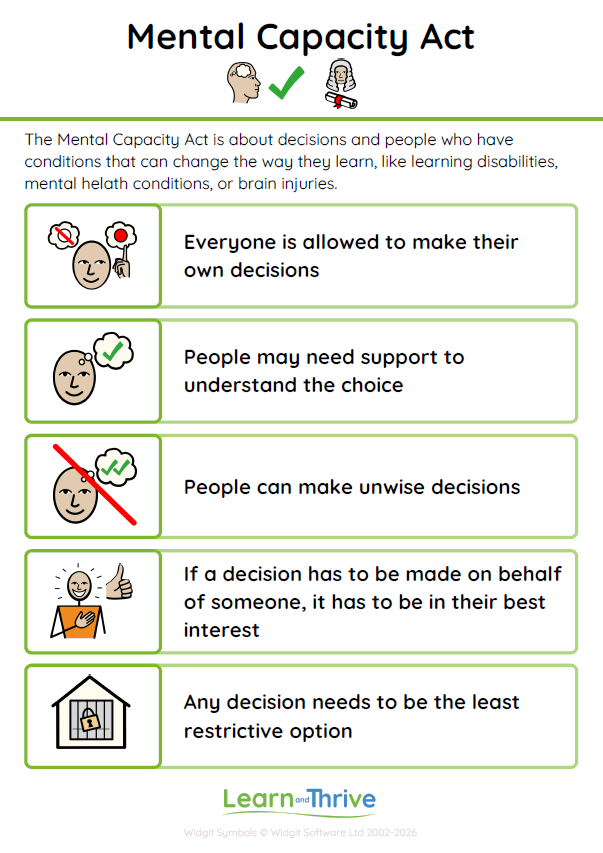
A preview of our Mental Capacity Act Poster - available in the upcoming series.
The Mental Capacity Act covers anyone in England and Wales over the age of 16 who has a condition which changes how they learn - like a learning disability, mental health issue, or brain injury. But what’s it for?
Helps people make choices and decisions for themselves
Looks at when individuals might need help and support in making these choices
Guidance about making a decision on someone’s behalf
There are 5 key areas to the Mental Capacity Act.
Everyone is allowed to make their own decision
We’ve already touched on this - the assumption in the law is always that the person should make decisions for themselves.
People may need support to understand the choice
This is something you’re likely to have come across before. As the best option is always for the individual to make their own decision, the first thing we can do is support them to make this decision. This means doing everything you can to support their understanding, easy-read, symbol support, AAC, or any other support systems that help them manage information and communicate.
People can make unwise decisions
As parents, this can be a hard one to swallow! But we didn’t always make the best decisions, did we?!
If the individual has the capacity to make the decision, and/or has been adequately supported to do so, then they have a right to make an ‘unwise’ decision. These decisions could be something you simply wouldn’t do yourself, or something you think is going to be a problem further down the line. If they understand the choice and the consequences, then regardless of what is ‘unwise’ about it, they have a right to make this decision - just like you would!
A decision made on someone’s behalf must be in their best interest
These final two come into play when the individual is unable to understand the decision, even with support, then someone may need to step in to decide for them. This decision needs to be in their best interest.
The ‘best interest’ decision is often made by a group of people who know the person well. This could include family members, teachers, doctors, nurses, or social workers.
A decision made on someone’s behalf must be the least restrictive option
Finally, the decision must be the least restrictive option. This is directly tied to a decision being in the person’s best interest.
The group making the decision needs to choose the option that gives the person the most freedom and independence. For example, if the group have to decide on a new type of medication, they need to choose the one that:
Works the best
Has the least side-effects
The person can take by themselves (if possible)
If there is disagreement, or more support is needed, then people can go to the Court of Protection.
Claire Lightley, who we are working on this project with, does a lot of work with the Court of Protection. She supports individuals to understand the decisions facing them, and the reason they are at the Court. This experience has directly informed the learning in our upcoming series.
The Upcoming Series - Consent & Decisions
In May, we are filming the videos for the Consent series. Are we’re covering everything in this blog, plus even more. Giving our learners all the information they need will empower them to know their rights. Other topics covered in this series include:
Relationships & consent - understanding both parties need to consent to be in a relationship
Making decisions freely and willingly - consent without coercion
Physical boundaries - for themselves & respecting others'
Help & intervention which crosses physical boundaries (e.g. doctors visits, or personal care) - and that consent is still required
Assertiveness in giving and refusing consent - including verbal and non-verbal ways to give and refuse consent
Private information & surprises or secrets - identifying unsafe, coercive behaviour through silence
Online nudity and consent - the law & safe decision around sending and receiving nudes
This series has bridges the gap between our stage 1 and stage 2 of the Learning for Life project. As we move into developing stage 2, Consent is a crucial skill that learners need to grasp before moving on to sexual consent, relationships, and sexual acts.
Planning to launch in July 2026, we’ll be bringing you all the content you need to do this series at home, in support groups, and at school. As always, access to all the videos is free, so sign up now if you haven’t already got Learning for Life access.